
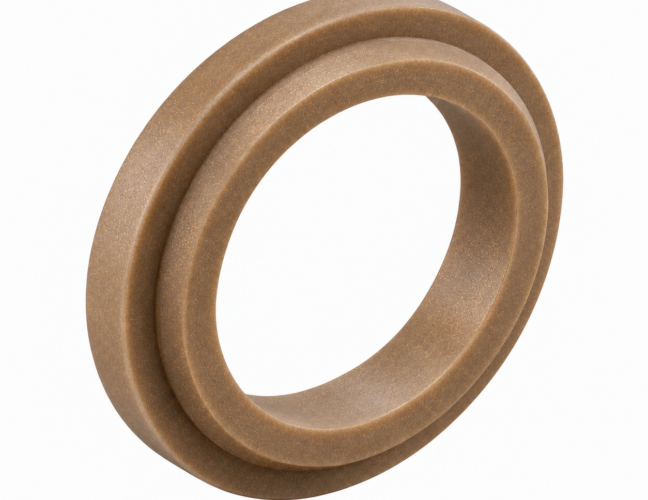
Bronze-filled PTFE provides improved wear resistance, compressive performance and thermal conductivity compared with virgin PTFE, making it suitable for demanding mechanical and sealing applications.
Actual material performance depends on the bronze filler content, PTFE grade, component geometry and operating conditions.
Custom-Machined Bronze-Filled PTFE Components
International Seal supports the supply of custom-machined bronze-filled PTFE components for industrial sealing, bearing and mechanical engineering applications. Components can be manufactured to customer drawings, existing part numbers, dimensional specifications or physical samples, with material grade and manufacturing requirements reviewed against the application.
Machined components may include:
When specifying bronze-filled PTFE components, important considerations include dimensional tolerances, mating surface materials, operating loads, temperature and movement. For repeat requirements, customers can provide annual usage forecasts or scheduled quantities to support production planning and supply arrangements.
Why Choose Bronze-Filled PTFE for Seals & Components?
Bronze-filled PTFE is commonly selected where the low-friction characteristics of PTFE are required alongside improved mechanical performance. The addition of bronze fillers can increase wear resistance, improve resistance to deformation under sustained loading and enhance thermal conductivity compared with virgin PTFE. These characteristics make bronze-filled PTFE particularly useful for bushes, bearings, wear rings and guide components exposed to repeated sliding movement.
However, bronze-filled PTFE does not provide the same broad chemical resistance as virgin PTFE. The bronze filler can be unsuitable for certain corrosive or oxidising environments, and compatibility with the operating media must be reviewed.
International Seal can assist with reviewing the required component design and material specification to identify a suitable sealing or bearing solution.For detailed filler compositions, mechanical properties and material specifications, refer to our Bronze-Filled PTFE Material & Properties Guide.
Bronze-Filled PTFE Seals & Components FAQs
What bronze-filled PTFE components do you supply?
International Seal supplies bronze-filled PTFE bushes, bearings, wear rings, guide rings, sealing rings, washers, spacers and custom-machined components for industrial engineering applications.
Can bronze-filled PTFE components be manufactured to a drawing?
Yes. International Seal can review requirements for bronze-filled PTFE parts manufactured to customer drawings, dimensions, existing specifications or physical samples.
Can you supply bronze-filled PTFE bushes and bearings?
Yes. We can support requirements for custom bushes and bearing components manufactured from suitable bronze-filled PTFE grades.
Are bronze-filled PTFE components suitable for hydraulic applications?
Bronze-filled PTFE is used in suitable hydraulic guiding, bearing and wear applications. Material selection must account for operating pressure, fluid compatibility, temperature and component design.
Can bronze-filled PTFE be used for seals?
Yes. Bronze-filled PTFE can be used in engineered sealing components where the application benefits from improved wear resistance and mechanical characteristics. The correct material grade and sealing design must be selected for the operating conditions.
What is the difference between virgin PTFE and bronze-filled PTFE?
Virgin PTFE provides excellent chemical resistance, electrical insulation and low-friction properties. Bronze-filled PTFE incorporates bronze fillers to improve wear resistance, creep resistance and thermal conductivity, although chemical compatibility may be more limited.
Is bronze-filled PTFE suitable for chemical processing?
Bronze-filled PTFE can be suitable for certain chemical processing environments, but the bronze filler may be affected by corrosive media. Chemical compatibility must be verified against the specific process fluid and operating conditions.
Need Bronze-Filled PTFE Seals or Machined Components?
International Seal supplies bronze-filled PTFE seals, bushes, bearings and custom-machined components for industrial sealing and engineering applications throughout the UK and internationally. Whether you require a replacement wear ring, precision-machined bush, bearing component or specialist PTFE part, our team can review your requirements and provide a competitive quotation.
Send us your component drawing, dimensions, material specification and required quantity. For specialist applications, include the operating temperature, pressure, process media, mechanical loading and movement requirements so that an appropriate material and manufacturing specification can be considered.