
Ceramic Products & Components
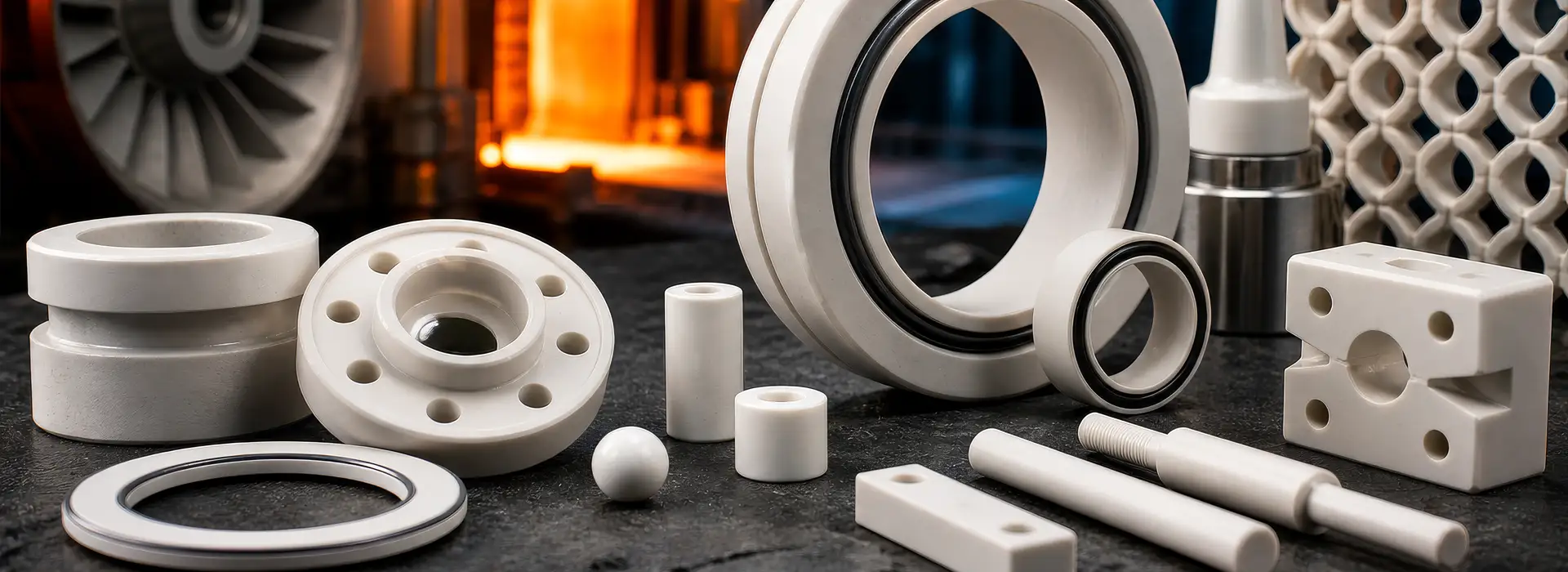
Ceramic Seal Faces, Wear Parts & Components
Ceramic Materials & Applications
Ceramic Seal Faces for Pumps and Mechanical Seals
The most common sealing use for technical ceramics is the seal face itself. In a mechanical seal, one or both faces run against each other continuously, and the material pairing determines wear rate, heat generation and how the seal behaves if it runs dry.
Zirconia is chosen where toughness matters and the face has to resist chipping. Silicon carbide combines hardness with high thermal conductivity, which draws heat out of the face and makes it the usual choice for demanding duties and dry-running tolerance. Alumina is a cost-effective face material for less severe service, and doubles as an electrical insulator.
Ceramics are also specified as wear parts where abrasive media would destroy a metal component — valve trim, pump wear rings, pistons and nozzles. For these, the grade and purity matter more than the material name: alumina content, typically 95% or 99.5%, along with density, hardness and flexural strength, determine how a part performs. Tell us the duty, the media and any dimensional tolerance required and we will confirm the grade and supply the material data.
Material Properties & Documentation
Components are supplied against the material grade, purity, dimensional tolerances and surface finish specified by the customer, including requirements for alumina, zirconia, silicon carbide and other technical ceramic materials. Customer drawings and application-specific specifications can also be supported.
Where a programme requires it, we source from manufacturing partners holding ISO 9001 certification, with material data, dimensional inspection reports and supporting quality documentation available where specified. Confirm the grade, tolerances and documentation requirements at enquiry stage.
Related Products
Custom moulded components, PTFE components, metal seals and FFKM seals for the same high-temperature and abrasive environments where technical ceramics are specified.
Technical Ceramic FAQs
Which ceramic is used for mechanical seal faces?
Silicon carbide and zirconia are the usual choices. Silicon carbide combines hardness with high thermal conductivity, which helps it tolerate marginal lubrication and dry running. Zirconia offers greater toughness and chip resistance. Alumina is used for less demanding duties at lower cost.
What is the difference between 95% and 99.5% alumina?
Alumina content affects hardness, density, flexural strength and chemical resistance. The 99.5% grade performs better in abrasive and chemically aggressive service; 95% is more economical and adequate for many wear and insulation duties. Specify the grade when the component is performance-critical.
Why use ceramic instead of metal for wear parts?
Ceramics hold their hardness at temperatures and in chemical environments where metals corrode or soften, and resist abrasion far better. They are used for valve trim, pump wear rings, pistons and nozzles where abrasive media would quickly destroy a metal part.
Can you supply ceramic components to a drawing?
Yes. Standard and fully bespoke ceramic parts are supplied in the grade the application requires, with material grade data and dimensional reports available on request. Confirm the grade, purity and any dimensional tolerance at enquiry stage.
Do you supply ceramic components for semiconductor equipment?
Yes — chamber components and wear parts for high-temperature and abrasive conditions. See our semiconductor equipment sealing page.