
Food & Beverage Sealing Solutions
Food Grade Seals & Hygienic Gaskets for Processing
Food & Beverage Inventory
CIP, SIP and Why Seals Fail Early in Food Plant
In food and beverage processing the cleaning regime is often harder on a seal than the product it handles. A compound can be perfectly compatible with the product and still fail in months because of the caustic, acid or steam cycle used to clean the line.
When specifying, consider the cleaning conditions alongside the production conditions: the cleaning agents and their concentration, the temperature, the exposure time and how often the cycle runs. Where steam or elevated-temperature cleaning is used, that is frequently the governing condition rather than the process temperature.
EPDM is the usual choice for water-based products and CIP chemistry. FKM is selected where oils, fats or higher temperatures are involved, but its suitability has to be checked against the cleaning cycle as well as the product. If seals in a particular line are being changed more often than you would expect, send us the product, the cleaning regime and the current compound and we will tell you whether the material is the reason.
Contaminant Detectable Compounds
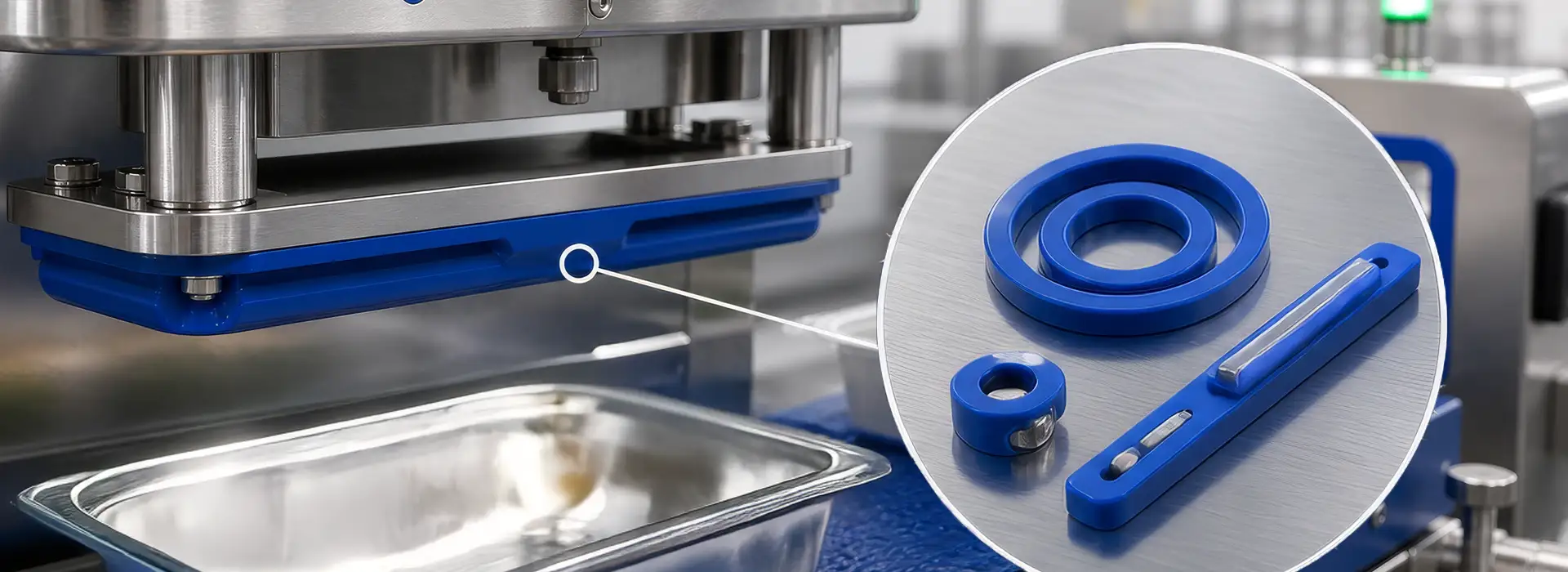
Foreign body contamination is one of the highest risks in food manufacturing. Our contaminant detectable range is engineered so that fragments can be identified by metal detection and X ray inspection systems, supporting HACCP plans and reducing the risk of costly product recalls.
Industry Standards & Compliance
Hygienic sealing materials must meet strict food contact and contamination control requirements. We supply compounds tested and certified to the standards food, dairy and beverage processors specify, including:
Material certification and test reports are available on request. Confirm the specification and any detectability requirement at enquiry stage and we will supply the matching certified compound.
Related Products
Hygienic seals and sanitary gaskets including Tri-Clamp, RJT, DIN 11851 and SMS, metal and X-ray detectable compounds, FDA and USP Class VI grades, industrial gaskets and custom moulded parts.
Food & Beverage Sealing FAQs
What is a food grade seal?
A seal made from a compound approved for food contact, with documentation to evidence it. In the UK and Europe the usual references are FDA CFR 21 177.2600, EC Regulation 1935/2004 and EU Regulation 10/2011, with 3-A Sanitary Standards applying to hygienic process equipment. Compliance applies to a specific compound and grade, not to a material family as a whole.
Which material should I use for food and beverage seals?
EPDM for water-based products and CIP cleaning; FKM where oils, fats or higher temperatures are involved; silicone where a wide temperature range is needed; PTFE and FFKM for the most demanding chemical duties. Because the cleaning regime is often the governing condition, select against both the product and the clean.
What are metal detectable seals and when are they needed?
Compounds containing additives that allow fragments to be identified by metal detection or X-ray inspection, used where foreign-body control forms part of a HACCP plan. Detection performance depends on the compound, fragment size, the product being inspected and the equipment in use, so it should be validated under your own production conditions. See our metal detectable seals guide.
Which hygienic fitting standard applies to my connection?
The seal is determined by the fitting, not the pipe. Tri-Clamp connections use BS 4825 Part 3 gaskets, RJT unions use BS 4825 Part 5 joint rings, DIN 11851 threaded unions use DIN 11851 seals, and SMS unions use SMS 1149 seals. Dimensions differ between standards, so a gasket from one system will not seal in another. See our hygienic seals range.
Can you supply seals with food-contact documentation?
Material certification and test reports are available on request for the compounds we supply. Tell us which declaration you need — FDA, EC 1935/2004, 3-A or USP Class VI — at enquiry stage so the correct grade is quoted from the outset.
Can you identify an existing gasket from a sample?
Yes. Photographs, measurements, an existing part number or a physical sample are all usually enough to identify the fitting and profile. Nominal pipe size alone will not identify the correct seal.