
Metal E-Rings
Metal E-rings, also known as metal E-seals, are high-performance static sealing solutions designed for high-temperature, high-pressure, vacuum and demanding industrial applications where conventional elastomeric seals may not provide the required performance.
The characteristic E-shaped cross-section incorporates multiple flexible sealing legs, providing controlled spring action and recovery when the seal is compressed between mating surfaces. This resilience makes metal E-rings particularly suitable for applications involving thermal cycling, pressure fluctuations and movement between mating components.
International Seal supplies standard and custom metal E-ring seals in stainless steels, nickel-based superalloys and specialist metals. Seals can be supplied to customer drawings, existing specifications or application requirements, with a range of materials, dimensions and surface coatings available.
Metal E-Ring Specifications
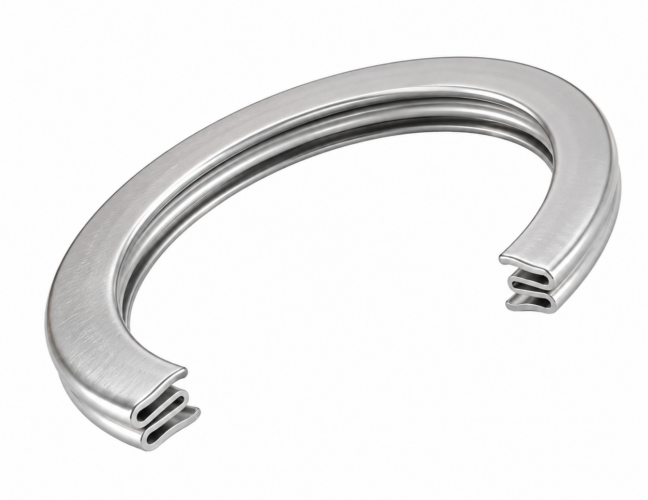
Metal E-rings are designed for critical static sealing applications where high temperature, pressure, vacuum conditions or repeated thermal cycling place significant demands on the sealing system.
- Resilient Metal E-Seal Construction
- Internal & External Pressure Configurations
- High Springback & Recovery
- High-Temperature & High-Pressure Applications
- Vacuum & High-Vacuum Applications
- Surface Platings & Coatings Available
- Supplied to Drawings or Application Requirements
Materials & Surface Coatings
Metal E-rings can be manufactured from a range of stainless steels, nickel-based superalloys and specialist materials. Material selection should consider operating temperature, pressure, process media, corrosion resistance, thermal cycling and the mechanical requirements of the sealing system.
A range of surface platings and coatings can be applied to metal E-rings to improve sealing performance, surface conformity and corrosion resistance.
Depending on the application, options include silver, gold, copper, nickel, tin, PTFE-based coatings and specialist plating combinations. Selection should consider operating temperature, pressure, flange surface finish, available seating load and required leakage performance.
For further information, see our Metal Seal Platings and Coatings section.
Typical Applications
Metal E-rings are used in demanding static sealing applications where conventional elastomeric or polymer seals may be unsuitable because of extreme temperatures, high pressures, vacuum conditions or repeated thermal and mechanical cycling.
The flexible E-shaped profile provides high resilience and springback, making these seals particularly suited to applications where the sealing joint may experience flange movement, thermal expansion or changing operating pressures.
- Aerospace & Defence Equipment
- High-Pressure Flanges & Connections
- High-Temperature Process Equipment
- Vacuum & High-Vacuum Systems
- Turbines, Engines & Exhaust Systems
- Valves, Pumps & Compressors
- Chemical & Petrochemical Processing
- Power Generation & Energy Systems
- Pressure Vessels & Critical Static Joints
The correct metal E-ring material, pressure orientation, cross-sectional geometry and surface coating should be selected according to operating temperature, pressure differential, flange movement, available seating load, mating surface finish, process media and required leakage performance.
Metal E-Ring Configurations
Metal E-rings can be manufactured in different orientations and section geometries depending on the direction of pressure, available sealing space and performance requirements of the application.
Internal Pressure Metal E-Rings
Internal pressure E-rings are orientated so that system pressure acts within the open section of the seal. Increasing pressure can assist in energising the sealing profile against the mating surfaces, while the resilient E-shaped section helps maintain sealing contact through pressure and temperature changes.
These designs are particularly suited to internally pressurised flanges, aerospace assemblies, turbines, pressure vessels and other demanding high-pressure systems.
External Pressure Metal E-Rings
External pressure E-rings are configured for applications where the pressure differential acts from outside the sealed cavity. The seal orientation allows external pressure to act on the E-section while maintaining controlled contact with the mating surfaces.
External pressure designs can be used in vacuum equipment, specialised pressure systems and applications where external pressure or vacuum conditions determine the direction of seal energisation.
Custom Metal E-Rings
Custom metal E-rings can be supplied for applications requiring specific diameters, cross-sections, materials, spring characteristics or surface treatments.
International Seal can support requirements based on new applications, customer drawings, existing seal specifications and replacement components, including alternative metal E-seals for existing equipment.
Metal E-Rings, C-Rings and O-Rings Compared
Metal E-rings are usually chosen over other metallic profiles for one reason: the joint moves. The multiple flexible legs of the E-section give greater elastic recovery than a C-ring or metal O-ring of comparable size, so the seal can follow more flange separation before sealing contact is lost, and it seats at a lower load.
As a general guide:
- Metal E-rings — highest springback, lowest seating load. Specified where thermal expansion, flange movement or joint separation is expected, as in turbine and duct casings.
- Metal C-rings — moderate springback and load, with system pressure able to energise the open C-section as pressure rises.
- Metal O-rings — lower springback, generally higher seating load, and a narrower contact band that can produce higher contact stress where load is available.
Performance in any specific joint depends on diameter, section geometry, wall thickness, alloy, material condition, surface coating and the design and condition of the sealing groove.
Metal E-Ring FAQs
What is a metal E-ring?
A metal E-ring is a static sealing ring with an E-shaped cross-section incorporating multiple flexible sealing legs. The profile gives controlled spring action and recovery under compression, which makes it suitable for joints subject to thermal cycling, pressure fluctuation and movement between mating components.
What is the difference between a metal E-ring and a metal E-seal?
None — the terms describe the same component and are used interchangeably, as are metallic E-seal and E-ring seal.
Why are metal E-rings used instead of metal O-rings?
Chiefly for springback. The flexible E-section recovers more than a metal O-ring after compression and seats at a lower load, so it can follow greater flange separation. Where a joint is stable and clamping load is plentiful, a metal O-ring may be simpler and more economical.
Can metal E-rings be used at high temperature?
Metal E-rings are commonly specified for high-temperature duties including turbines, engines, exhaust systems and hot ducting. Temperature capability depends on the alloy, material condition and surface coating selected, so send us the operating temperature and we will confirm what can be supplied.
Can metal E-rings be used in vacuum applications?
Yes. E-rings are used in vacuum equipment, configured as external pressure designs so that the inward differential energises the seal correctly.
Can you supply metal E-rings to a drawing or part number?
Yes. Metal E-rings can be manufactured to customer drawings, dimensions or application requirements across a range of diameters, cross-sections, spring characteristics, alloys and surface treatments, including alternative metal E-seals for existing equipment.
Need a Metal E-Ring?
Send us the seal or groove dimensions, direction of pressure, operating temperature and pressure, expected flange movement, process media and quantity where known, and we will confirm the configuration, alloy and coating that suit the joint.
Drawings, manufacturer part numbers, photographs and physical samples can all be reviewed where you are replacing an existing seal or sourcing an alternative.