
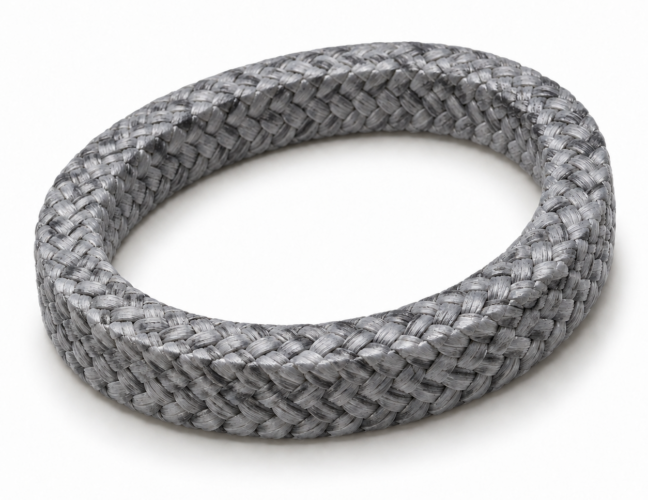
Graphited PTFE gland packing combines low-friction sealing characteristics with good chemical resistance and heat dissipation for industrial equipment.
Operating temperature, pressure, shaft speed and chemical compatibility depend on the specific packing construction, graphite content, lubricant and operating conditions.
What is Graphited PTFE Gland Packing?
Graphited PTFE gland packing is a braided sealing material manufactured from PTFE yarns incorporating graphite to improve frictional and thermal characteristics. The material is designed to combine the chemical resistance and low-friction properties of PTFE with the heat-dissipating characteristics of graphite. It is installed into the stuffing box of pumps, valves and other industrial equipment, where compression from the gland follower creates a sealing interface around the shaft or spindle.
Compared with conventional pure PTFE packing, graphited PTFE can offer improved thermal conductivity, making suitable constructions useful in rotating equipment where frictional heat must be managed. Graphited PTFE packing is frequently used in chemical processing, water treatment and general industrial fluid handling applications. The exact performance depends on the PTFE yarn construction, graphite content, braid density, lubrication and operating conditions.
Graphited PTFE Gland Packing Properties
Low Friction
Graphited PTFE provides low-friction characteristics, helping reduce resistance between the packing and shaft or spindle. This can be particularly beneficial in rotating equipment where excessive friction may contribute to heat generation and shaft wear. Correct installation, lubrication and gland adjustment remain important to achieve reliable sealing performance.
Thermal Conductivity
The addition of graphite improves the thermal conductivity of PTFE-based packing, helping transfer heat away from the sealing interface. This makes graphited PTFE a useful option for selected rotating pump applications where heat generated through friction must be managed. The degree of improvement depends on the graphite content and packing construction.
Chemical Resistance
Graphited PTFE offers good resistance to many industrial chemicals, including a wide range of oils, solvents, acids and alkalis. However, graphite-containing PTFE packing does not necessarily provide the same chemical compatibility as pure PTFE. Certain oxidising chemicals or other aggressive environments may affect the complete packing construction.Chemical compatibility should therefore be checked against the specific operating media and packing grade.
Sealing Flexibility
Braided graphited PTFE packing provides a flexible sealing material that can conform to gland surfaces when compressed. Its ability to maintain an effective sealing interface depends on the packing cross-section, installation, gland loading and operating conditions.
Graphited PTFE Gland Packing Constructions
Different graphited PTFE packing constructions can be selected according to shaft speed, temperature, pressure and process media.
Braided Graphited PTFE Packing
Braided graphited PTFE packing is manufactured from PTFE yarns incorporating graphite. It offers a combination of chemical resistance, low friction and improved thermal conductivity for suitable industrial pump and valve applications.
Lubricated Graphited PTFE Packing
Selected graphited PTFE packing grades incorporate additional lubricants to reduce friction and improve operation in suitable rotating equipment. Lubricant selection can affect the packing's chemical compatibility and temperature limits.
Expanded Graphited PTFE Packing
Expanded graphited PTFE packing uses flexible expanded PTFE yarns incorporating graphite. Its conformable structure can provide useful sealing characteristics in suitable pumps, valves and industrial equipment. The correct construction should be selected against the equipment design and operating conditions.
Typical Graphited PTFE Gland Packing Applications
Graphited PTFE gland packing is widely used in industrial applications requiring a combination of low friction, chemical resistance and thermal performance.
Typical applications include:
Suitability for individual applications depends on the packing construction, shaft speed, temperature, pressure and process media.
Graphited PTFE Packing for Pumps & Valves
Graphited PTFE gland packing is commonly selected for pump applications where low friction and heat dissipation are important. In rotating pumps, graphite-containing PTFE yarns can help manage frictional heat while providing a flexible sealing interface around the shaft. Suitable packing constructions can provide effective sealing for a wide range of industrial fluids, provided the material is compatible with the operating environment.
In valve applications, graphited PTFE packing can provide low-friction sealing around valve stems where the selected construction meets the required temperature and pressure conditions. Correct packing installation, gland adjustment and lubrication are essential for achieving reliable sealing performance.
Graphited PTFE Gland Packing Material Selection
Graphited PTFE gland packing is commonly selected where low friction, chemical resistance and improved thermal conductivity are required. Compared with Pure PTFE Gland Packing, graphited PTFE generally provides better heat dissipation, making it useful in suitable rotating pump applications.
Graphite Gland Packing may be more suitable for higher-temperature applications, particularly where thermal conductivity and steam sealing performance are priorities.
Aramid Gland Packing may provide greater mechanical strength and abrasion resistance for demanding applications involving abrasive fluids.
Carbon Fibre Gland Packing can offer an alternative combination of thermal stability, mechanical strength and wear resistance. The correct packing material should always be selected against the operating media, temperature, pressure, shaft speed and equipment design.
Graphited PTFE Gland Packing FAQs
What is graphited PTFE gland packing?
Graphited PTFE gland packing is a braided sealing material manufactured from PTFE yarns containing graphite. It combines the low-friction and chemical-resistant characteristics of PTFE with improved thermal conductivity.
What is graphited PTFE gland packing used for?
Graphited PTFE gland packing is used to seal shafts and valve stems in pumps, valves, mixers, agitators and other industrial equipment.
What is the difference between PTFE and graphited PTFE gland packing?
Pure PTFE packing provides excellent chemical resistance and low friction. Graphited PTFE incorporates graphite to improve thermal conductivity and heat dissipation. The addition of graphite can also alter chemical compatibility and other operating characteristics.
Is graphited PTFE gland packing suitable for pumps?
Yes. Suitable graphited PTFE constructions are widely used in industrial pumps where low friction and heat dissipation are important. The correct grade must be selected according to shaft speed, pressure, temperature and process media.
Can graphited PTFE gland packing be used in valves?
Yes. Graphited PTFE packing can be used for valve stem sealing where the construction is compatible with the operating conditions.
Is graphited PTFE gland packing chemically resistant?
Yes. Graphited PTFE provides good resistance to many industrial chemicals. However, chemical compatibility should be confirmed against the complete packing construction, including graphite and any lubricants.
What is expanded graphited PTFE packing?
Expanded graphited PTFE packing is manufactured from flexible expanded PTFE yarns incorporating graphite. It can provide good conformability, low friction and improved heat dissipation in suitable applications.
Need Graphited PTFE Gland Packing?
International Seal supplies graphited PTFE gland packing for pumps, valves and industrial process equipment across the UK and internationally. Send us your required packing cross-section, quantity and application details, and our team will provide a competitive quotation.
For specialist applications, include the operating temperature, pressure, shaft speed and process media so that the suitability of the packing material can be reviewed.